

Cap table management software in 2026 ranges from enterprise-grade platforms built for later-stage financings to lightweight tools a pre-seed founder can set up before lunch. Best overall cap table management software: Carta. Best for syndicate leads running SPVs: AngelList's Stack. Best for lean pre-seed teams: LTSE Equity.
- Carta is the best cap table management software overall for venture-backed startups running 409A valuations at scale in 2026.
- AngelList's Stack fits syndicate leads who need SPV administration tied directly to their cap table.
- Pulley and Ledgy solve narrower problems: fast scenario modeling and multi-currency global option pools.
- LTSE Equity suits pre-seed founders who want a simple option ledger without enterprise overhead.
- A clean cap table is one of the first things angel investors check before writing a check.
Why this matters
A messy cap table kills momentum during diligence. Investors reviewing a startup in 2026 expect to see clean share classes, correctly modeled SAFEs, and a 409A valuation that hasn't lapsed — not a spreadsheet with three conflicting versions.
The diligence checklist taught inside AngelSchool's programs treats cap table hygiene as a red flag test: if a founder can't answer a basic dilution question in under a minute, that's a signal worth noting before a check gets written. Picking the right cap table management software matters just as much for the angel investor evaluating the deal as it does for the founder running the company.
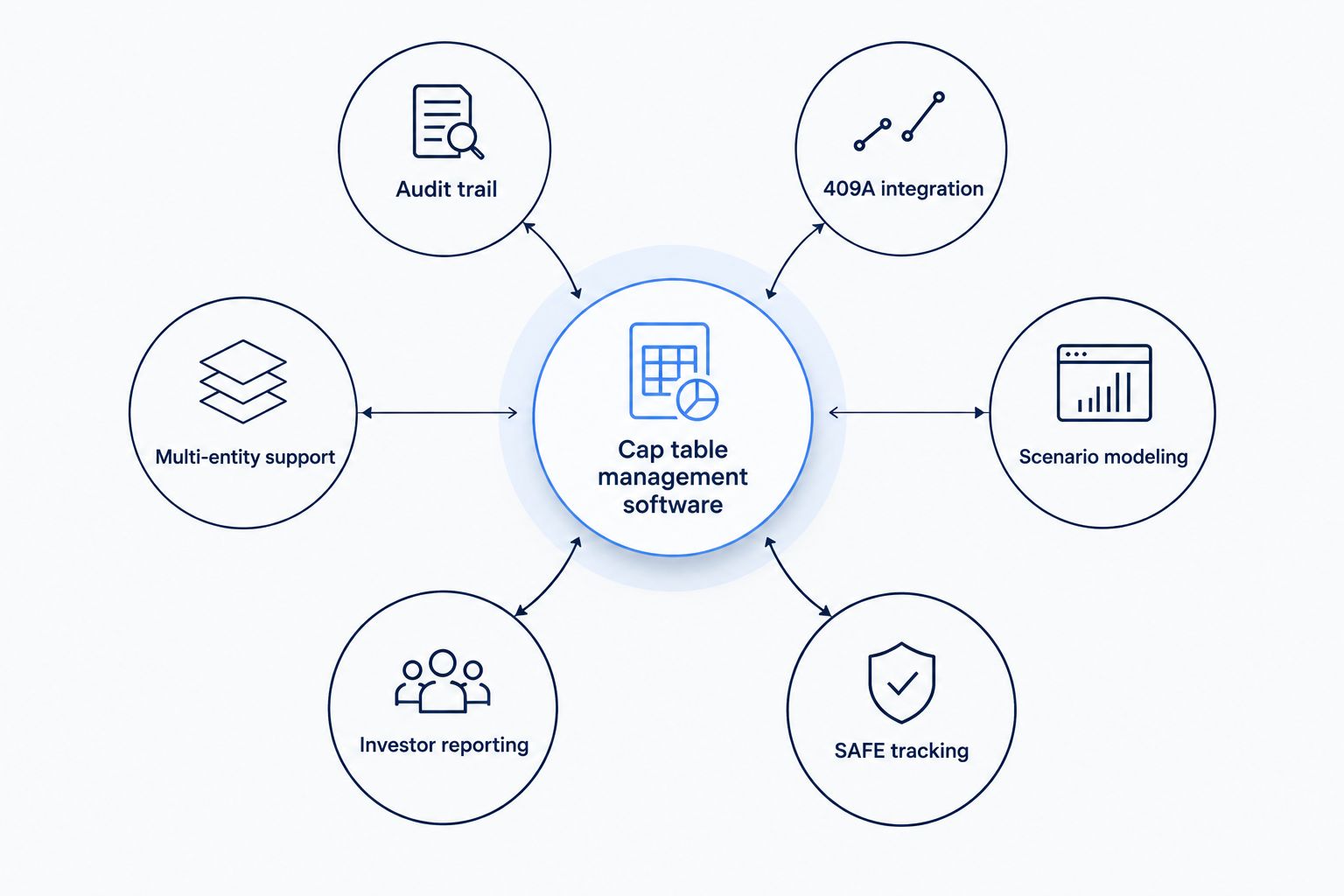
What makes the best cap table management software
- Audit trail and version history — every issuance, cancellation, and transfer time-stamped and immutable.
- 409A valuation integration — built-in ties to independent providers, refreshed inside the IRS's 12-month safe harbor window or after a material event.
- Scenario and waterfall modeling — dilution and exit waterfalls modeled before a term sheet is signed, not after.
- SAFE and convertible note tracking — instruments modeled correctly at conversion, not left as static rows.
- Investor and LP reporting — automated ownership visibility for SPV members and LPs.
- Multi-entity and multi-currency support — needed once a startup has more than one jurisdiction or a global option pool.
Cap table management software at a glance
| Tool | Best for | Standout feature | Key limitation |
|---|---|---|---|
| Carta | Venture-backed startups doing 409A at scale | Audit-grade record keeping trusted by law firms | Heavier setup for a handful of shareholders |
| Pulley | Early-stage founders modeling scenarios themselves | Founder-friendly waterfall modeling | Smaller network of integrated law firms |
| Ledgy | International, multi-currency cap tables | Built around EU/UK equity plan rules | Less recognition among US-based VCs |
| AngelList (Stack) | Syndicate leads managing SPVs | Cap table tied directly to SPV administration | Thinner 409A tooling for a full operating company |
| Cake Equity | APAC-based startups and lean teams | Regional tax and ESOP support | Smaller footprint outside APAC |
| LTSE Equity | Pre-seed founders wanting a simple ledger | Direct 409A ordering from day one | Fewer advanced modeling features |
1. Carta: best cap table management software for venture-backed startups running 409A valuations at scale
Carta manages equity issuance, ties directly into 409A valuation ordering, and gives investors a reporting portal most VC-backed companies already recognize. It's the default a startup's lawyers and auditors expect to see once a company has raised a priced round.
Carta pros:
- Audit-grade record keeping that law firms and auditors already trust
- 409A valuation ordering built into the platform
- Investor update portal that saves founders manual reporting work
- Wide familiarity across accountants and startup counsel, which shortens diligence
Carta cons:
- Overkill for a company with a handful of shareholders and no priced round yet
- Onboarding takes longer for founders unfamiliar with equity compliance terms
Best for: venture-backed startups post-priced round. Verdict: Buy.
2. Pulley: best cap table management software for early-stage founders who want fast scenario modeling
Pulley pairs cap table tracking with waterfall and dilution modeling built for founders who don't have a finance team modeling every round in a spreadsheet. It's built to migrate a founder off Google Sheets without a steep learning curve.
Pulley pros:
- Scenario modeling accessible without a finance background
- Migration support for founders coming off spreadsheets
- Shareable, investor-friendly cap table links
Pulley cons:
- Smaller network of integrated law firms compared to Carta
- Fewer tools for later-stage secondary transactions
Best for: seed-stage founders modeling their own rounds. Verdict: Buy.
3. Ledgy: best cap table management software for international, multi-currency cap tables
Ledgy was built in Europe for startups with cross-border teams, multi-currency option pools, and equity plans that need to comply with EU and UK vesting and tax rules. It fills a gap most US-centric tools handle poorly.
Ledgy pros:
- Strong support for multi-entity structures spanning the EU and UK
- Equity plan compliance built around European tax and vesting rules
- Investor reporting available in multiple currencies
Ledgy cons:
- Less brand recognition among US-based VCs and law firms
- Migration from a US-centric tool adds setup time
Best for: startups with entities or employees outside the US. Verdict: Buy.
4. AngelList (Stack): best cap table management software for syndicate leads managing SPVs
Stack ties cap table data directly to AngelList's SPV and fund administration infrastructure, which matters for angel syndicate leads tracking LP ownership across multiple deals rather than a single operating company. Anyone building a syndicate — the exact skill taught in AngelSchool's Syndicate Blueprint program — ends up needing this kind of tooling once deal volume grows past two or three SPVs.
AngelList (Stack) pros:
- Cap table data tied directly to SPV formation and LP reporting
- Built for syndicate leads running multiple deals at once
- Familiar to angel investors already sourcing dealflow through AngelList
AngelList (Stack) cons:
- Not the right fit for a single operating company's full cap table outside AngelList's SPV infrastructure
- Feature depth for later-stage 409A work is thinner than Carta's
Best for: syndicate leads and angel investors running SPVs. Verdict: Buy.
5. Cake Equity: best cap table management software for APAC-based startups and lean teams
Cake Equity is popular among Australian and Southeast Asian startups and covers cap table tracking, ESOP administration, and valuations in one place. It's a regional pick, not a global default.
Cake Equity pros:
- Strong regional support for APAC tax and compliance rules
- Simple interface suited to a small founding team
- ESOP administration built directly into the platform
Cake Equity cons:
- Smaller footprint outside APAC
- Fewer integrations with US-based law firms and 409A providers
Best for: APAC-based founding teams. Verdict: Hold — strong regional fit, skip if your investor base is US-heavy.
6. LTSE Equity: best cap table management software for pre-seed founders who want a simple option ledger
LTSE Equity, built by the Long-Term Stock Exchange group, covers cap table tracking, 409A ordering, and option grants aimed at first-time founders who don't need enterprise complexity yet.
LTSE Equity pros:
- Straightforward setup for a first-time founder
- Direct 409A valuation ordering from day one
- Governance-first philosophy that pairs well with a small board
LTSE Equity cons:
- Fewer advanced scenario modeling tools than Pulley
- Smaller network of integrated law firms
Best for: pre-seed founders setting up their first cap table. Verdict: Buy for now, revisit once you raise a priced round.
Learn to read a cap table like an investor
AngelSchool's programs teach the diligence checklist behind every deal.
How we ranked
Each tool above was measured against the six criteria listed earlier: audit trail integrity, 409A integration, scenario modeling depth, SAFE and note tracking, investor/LP reporting, and multi-entity support. No tool wins on all six — the ranking reflects which criteria matter most for a given stage or role, not a single leaderboard score.
“A clean cap table is the first diligence test in any deal, long before the term sheet.”
Which cap table management software should you choose?
If you've raised a priced round and need audit-grade records, Carta is the default choice in 2026. If you're pre-seed and want something simpler to set up, LTSE Equity or Pulley covers the same ground without the overhead. If you're running SPVs as a syndicate lead rather than managing one company's equity, AngelList's Stack is built for that job specifically — nothing else on this list is.
FAQ
What is the best cap table management software in 2026?
Carta is the best overall pick for venture-backed startups running 409A valuations at scale in 2026. Syndicate leads managing SPVs get more value from AngelList's Stack, and pre-seed founders often start with LTSE Equity or Pulley.
Is Carta worth it for a pre-seed startup?
Carta is often more than a pre-seed company needs before a priced round. LTSE Equity or Pulley cover the same basic cap table and 409A needs with a simpler setup.
How is cap table software different from a spreadsheet?
Cap table software keeps an audit trail of every issuance, cancellation and transfer, and models SAFEs and option pools correctly at conversion. A spreadsheet tracks none of that automatically and breaks down fast once a company has more than a few shareholders.
Do angel investors care which cap table software a startup uses?
Angel investors care less about the specific tool and more about whether the cap table is accurate and auditable. A cap table with unsigned grants or unmodeled SAFEs is a diligence red flag regardless of which software produced it.
What is Pulley best for?
Pulley is best for early-stage founders who want to model dilution and exit waterfalls themselves without a finance background. It's built for founders migrating off spreadsheets rather than for later-stage secondary transactions.
Can syndicate leads use cap table software to manage SPVs?
AngelList's Stack ties cap table data directly to SPV formation and LP reporting, which makes it the closest fit for syndicate leads running multiple deals. Generic cap table tools built for a single operating company handle this poorly.
How often does a 409A valuation need to be refreshed?
Under IRS safe harbor rules, a 409A valuation is valid for 12 months or until a material event, whichever comes first. Most cap table software with built-in 409A ordering flags this automatically.
Is Ledgy better than Carta for international startups?
Ledgy handles multi-currency, multi-entity cap tables and EU/UK equity plan compliance better than Carta does. Carta still has wider recognition among US-based law firms and auditors, which matters if most of your investors are US-based.
One last thing
The detail founders miss most often isn't the software — it's the unsigned option grant sitting in a cap table for months after the offer letter went out. Every tool on this list flags unsigned or unexercised grants somewhere in its dashboard; almost no founder checks that view before a diligence call. Angel investors trained through AngelSchool's Syndicate Blueprint are taught to ask for that exact screen before they ask for anything else — it takes thirty seconds to pull up and tells you more about how a founder runs the company than the pitch deck does.