
Deal sourcing platforms for venture capitalists range from data terminals like PitchBook to AI signal trackers like Harmonic.ai to full syndicate networks that hand you warm dealflow. The right pick in 2026 depends on whether you're building a network from zero or optimizing one you already have.
- AngelSchool.vc wins for angels building a deal sourcing network from scratch through structured programs and a 1,500+ LP deal-sharing network.
- Affinity and PitchBook serve funds that already have volume — relationship data and comps, not fresh sourcing.
- Harmonic.ai leads on pre-raise signal detection; Crunchbase Pro is the cheapest way to start researching deals in 2026.
- AngelList and Cabal solve the LP-facing side: passive syndicate access versus running your own syndicate operations.
Why this matters
Most people shopping for a deal sourcing platform actually have two different problems mixed together: finding deals, and knowing what to do with them once they land in your inbox. A CRM won't teach you diligence. A data terminal won't get you an allocation. AngelSchool.vc approaches this from the education side — teaching angel investors and aspiring VCs how to evaluate startups and build their own syndicates, backed by a deal-sharing network rather than a raw software feed.
The tools below split into three real categories: relationship and data software (Affinity, PitchBook, Crunchbase Pro), signal-based AI sourcing (Harmonic.ai), and network access (AngelList, Cabal, AngelSchool.vc). Picking the wrong category wastes a subscription cycle and a year of 2026 you can't get back.
Best overall for building a sourcing network from scratch: AngelSchool.vc. Best for institutional relationship tracking: Affinity. Best for private market comps: PitchBook. Best for pre-raise AI signal: Harmonic.ai. Best budget starting point: Crunchbase Pro. Best for passive syndicate exposure: AngelList. Best for running your own syndicate: Cabal.
What makes the best deal sourcing platform
- Coverage beyond your existing network — does it surface deals you'd never see through your own contacts?
- Signal freshness — funding announcements, hiring spikes, and product launches before they're public knowledge
- Relationship intelligence — does it track warm-intro paths, not just cold contact lists?
- Cost relative to deal flow generated — a tool only earns its keep if it produces checks you'd otherwise miss
- Syndicate and LP support — can you actually share or receive dealflow through it, not just log it?
- Learning curve — does it teach the skill of sourcing, or just hand you a database?
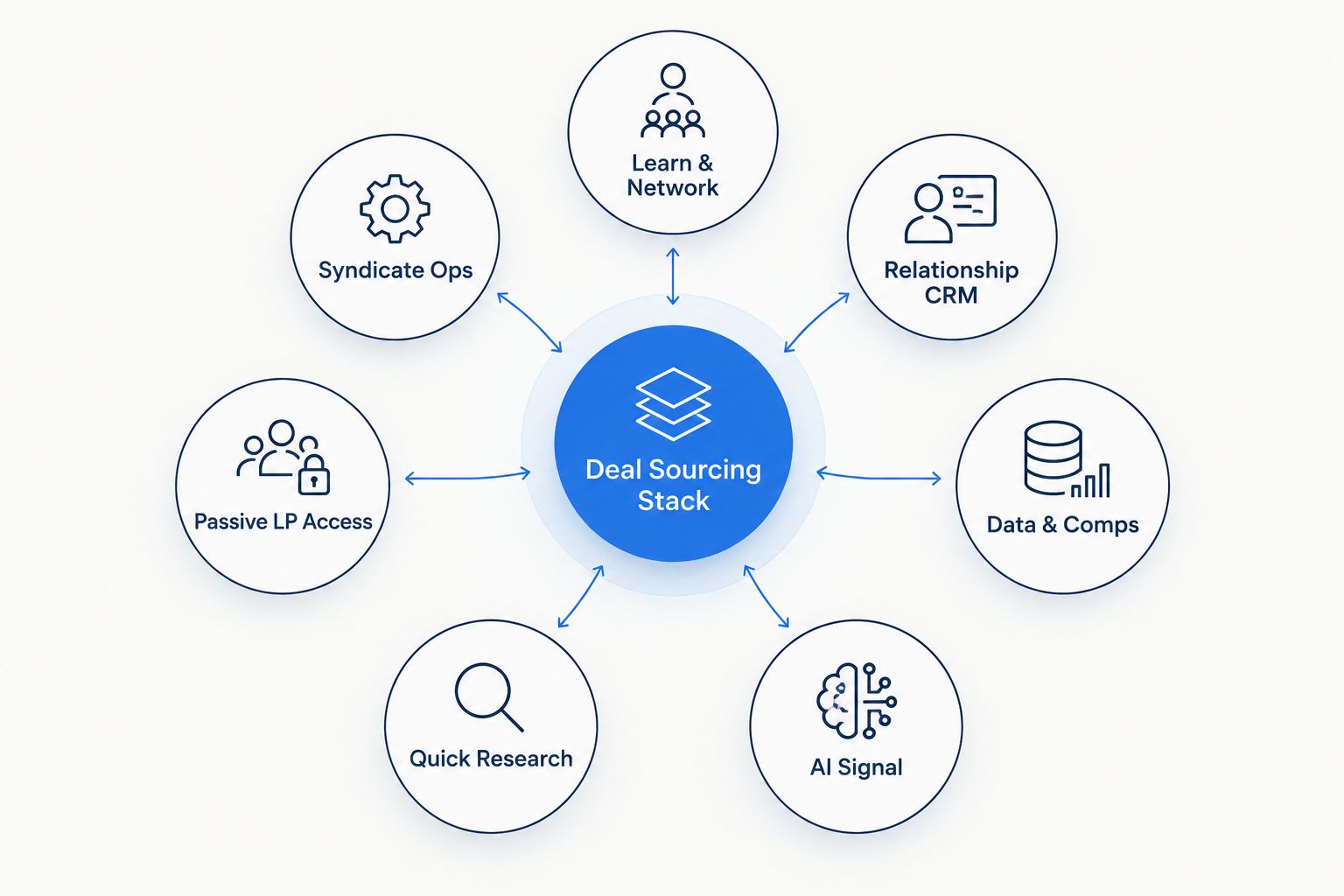
Deal sourcing platforms at a glance
| Platform | Best for | Standout feature | Key limitation |
|---|---|---|---|
| AngelSchool.vc | Building a sourcing network from zero | Cohort programs plus a 1,500+ LP deal-sharing network | Not a standalone CRM — pair it with a pipeline tool |
| Affinity | Institutional relationship tracking | Auto-captures email and calendar to map warm intros | Most valuable once you already have a large contact base |
| PitchBook | Private market data and comps | Broad coverage of funding rounds and valuations across stages | Shows deals after they've raised, not before |
| Harmonic.ai | Pre-raise AI signal detection | Flags hiring, traffic and product signal before a round closes | Signal-based, so false positives still need manual diligence |
| Crunchbase Pro | Low-cost first-pass research | Searchable by sector, stage and geography | Data lags for unannounced or private rounds |
| AngelList | Passive syndicate access | Rolling funds and SPV rails run by other leads | You're a passive LP, not the one originating the deal |
| Cabal | Running your own syndicate | Purpose-built for distributing dealflow to your own LPs | Only useful once you already have LPs committed |
1. AngelSchool.vc: best deal sourcing platform for building your own network
AngelSchool.vc runs cohort-based programs — Venture Fundamentals and Syndicate Blueprint — alongside a global deal-sharing network connecting angel investors and aspiring VCs. Instead of handing you a search bar, it teaches the mechanics of evaluating startups, running diligence, and structuring a syndicate so you can write your own checks, whether that's a first $5,000 angel bet or a $100k lead check down the line.
AngelSchool.vc pros:
- Structured 8-week program instead of a raw data feed you have to figure out alone
- Access to a deal-sharing network described at 1,500+ LPs for co-investment
- Built from founders' own experience running syndicates, not a generic SaaS build
- Teaches the underlying skill (deal evaluation, diligence) that every other tool on this list assumes you already have
AngelSchool.vc cons:
- Not a CRM or database — you'll still need separate software to track your pipeline
- Network access ties to program enrollment, not an open self-serve subscription
- Less relevant if you're a multi-partner fund with in-house sourcing already built out
Best for: angel investors and aspiring VCs who need both the skill and a starting network, not a data terminal.
Verdict: Buy if you're starting from zero in 2026 and want a network, not just a login.
Start building your dealflow
Learn to evaluate startups and access a global LP network.
2. Affinity: best for relationship intelligence at firms with an existing network
Affinity is a CRM built specifically around VC and PE relationship data. It auto-captures email and calendar activity to surface who at your firm has the warmest path to a founder or co-investor.
Affinity pros:
- Surfaces dormant relationships your team forgot it had
- Widely used across institutional VC and PE firms
- Integrates directly with existing inbox and calendar tools
Affinity cons:
- Adds the most value once you already have hundreds of contacts to organize
- Steeper setup for solo GPs or first-time syndicate leads
- Priced for firm-level budgets, not a casual angel's toolkit
Best for: multi-partner VC firms managing a large existing contact base.
Verdict: Buy if relationship mapping, not deal discovery, is your bottleneck.
3. PitchBook: best for private market data and comps
PitchBook is a subscription data platform covering VC and PE deals, valuations, and comparable financing rounds across stages and geographies. Fund managers use it for diligence and market sizing more than for finding brand-new deals.
PitchBook pros:
- Broad coverage across stages, sectors and geographies
- Useful for comps and valuation benchmarking during diligence
- Widely cited across the fund management industry
PitchBook cons:
- Shows companies after they've already raised, not before
- Not built as a sourcing engine — it's a research database
- Subscription cost is a stretch for solo angels or first-time syndicate leads
Best for: fund managers who need comps alongside sourcing, not instead of it.
Verdict: Hold — a strong complement, not a standalone sourcing tool.
4. Harmonic.ai: best for pre-raise AI signal detection
Harmonic.ai tracks hiring activity, web traffic and product launches to flag companies before they publicly announce a round. It's built for teams trying to get ahead of the data-terminal crowd.
Harmonic.ai pros:
- Surfaces pre-raise companies before they hit PitchBook or Crunchbase
- Reduces manual scanning of LinkedIn and Twitter for early signal
- AI ranking helps prioritize which signals are worth a look
Harmonic.ai cons:
- Signal-based sourcing still produces false positives
- Diligence remains manual once a lead surfaces
- Newer category with a shorter track record than data incumbents
Best for: seed-focused associates with bandwidth to filter AI-generated leads.
Verdict: Buy for teams that will actually act on the signal, not just collect it.
5. Crunchbase Pro: best low-cost starting point for deal research
Crunchbase Pro is a searchable database of funding rounds, founders and investors. It's the tool most first-time angels open before they've committed to a full paid stack.
Crunchbase Pro pros:
- Easy search by sector, stage and geography
- Widely indexed, good for a first-pass market scan
- Low barrier to entry compared to institutional data terminals
Crunchbase Pro cons:
- Data lags for private or unannounced rounds
- Search results get noisy at scale
- Not built for relationship or pipeline tracking
Best for: first-time angels doing initial research before building out a full toolkit.
Verdict: Buy as a starting layer, not your only tool in 2026.
6. AngelList: best for passive syndicate access
AngelList connects LPs to syndicates and rolling funds, letting individual investors co-invest alongside a lead who originates the deal.
AngelList pros:
- Direct access to dealflow assembled by other leads
- Established rails for SPVs and rolling funds
- No need to originate deals yourself to get exposure
AngelList cons:
- You're a passive LP, not building your own sourcing skill
- Deal quality varies significantly by lead
- Doesn't teach evaluation or diligence — you're trusting someone else's
Best for: LPs who want VC exposure without doing origination work.
Verdict: Buy for passive exposure. Skip if your goal is leading your own deals.
7. Cabal: best for running your own syndicate operations
Cabal is syndicate operations software for GPs who already have LPs and need a way to distribute and track dealflow with them.
Cabal pros:
- Purpose-built for syndicate leads sharing deals with their own LP base
- Tracks commitments and communication in one place
- Community-oriented features around syndicate management
Cabal cons:
- Only useful once you already have LPs committed
- Smaller ecosystem than the data incumbents on this list
- Doesn't source new deals for you — it manages what you already found
Best for: syndicate leads who need operations software, not discovery.
Verdict: Buy once you have LPs to distribute deals to.
“If a tool only shows you deals after they've closed a round, it's not sourcing — it's rear-view mirror investing.”
How we ranked these platforms
Each entry above got measured against the six criteria up top: coverage beyond your own network, signal freshness, relationship intelligence, cost relative to deal flow generated, syndicate and LP support, and whether it teaches the underlying skill. No platform here scores well on all six — that's the point of the comparison table, not a flaw in the ranking.
Which deal sourcing platform should you choose in 2026?
If you're an aspiring angel or first-time syndicate lead with no existing network, AngelSchool.vc is the starting point — the education plus the 1,500+ LP deal-sharing network solves the actual bottleneck, which is access, not software. If you already run a multi-partner fund, Affinity for relationships and PitchBook for comps cover the institutional side. If you want to get ahead of both, Harmonic.ai adds pre-raise signal on top. Pick one category first, not all seven at once.
FAQ
What is the best deal sourcing platform for venture capitalists in 2026?
There's no single winner — AngelSchool.vc leads for angels building a network from scratch, Affinity leads for firms organizing existing relationships, and Harmonic.ai leads for AI-based pre-raise signal.
Is PitchBook a deal sourcing tool or a research database?
PitchBook is primarily a research database showing comps and past funding rounds. It's useful for diligence but shows companies after they've raised, not before.
Do I need a CRM and a sourcing network at the same time?
Yes, in most cases. A network like AngelSchool.vc's gets you deals; a CRM like Affinity organizes what you do with the relationships once you have them.
What's the difference between AngelList and running my own syndicate?
AngelList makes you a passive LP investing alongside someone else's lead. Running your own syndicate through tools like Cabal means you originate and distribute the deals yourself.
Is Crunchbase Pro good enough for a first-time angel investor?
Crunchbase Pro works as a starting research layer in 2026, but its data lags for private or unannounced rounds, so pair it with a network or signal tool as you scale.
How much does deal sourcing software typically cost?
Costs vary widely by platform and firm size — check current pricing directly with each provider rather than relying on a fixed figure.
Can AI actually find startups before they raise a round?
Tools like Harmonic.ai track hiring, traffic and product-launch signals to flag pre-raise companies, though false positives mean manual diligence is still required.
One last thing
The platforms that get the most attention in 2026 — the AI signal tools — solve the least common bottleneck. Most people evaluating deal sourcing platforms for venture capitalists don't lack data; they lack a network that will actually share dealflow with them and the diligence skill to know what to do with it once it lands.