
Yes. You can lose money as a limited partner in a VC fund, including all the capital you contribute, if the fund’s investments fail to return enough to cover its costs. Your outcome depends on capital calls, fund expenses and distributions—not just the performance of the startups you hear about.
- Yes, you can lose money as a limited partner in a VC fund, including all capital contributed.
- A fund can sell successful investments and still leave LPs with a net loss after other losses and expenses.
- In 2026, read the capital-call, fee and distribution terms before signing a fund commitment.
- AngelSchool is best for aspiring VCs and angel investors learning diligence, not for assessing a specific fund’s legal terms.
Why this matters
A fund commitment is not the same as a single startup investment. The manager chooses a portfolio, calls capital under the fund agreement, pays expenses and distributes proceeds according to the governing documents. In 2026, your decision is whether those terms and that manager’s investment process justify tying up capital whose return is uncertain.
Dealflow matters, but access alone does not protect an LP. If you are evaluating how a manager finds opportunities, the guide to deal sourcing platforms for venture capitalists covers that part of the process. Here, the question is what reaches you after investments, costs and distributions.
Can you lose money as a limited partner in a VC fund?
Yes: an LP can receive less than the capital contributed, or nothing at all. A commitment is an obligation to provide capital under the fund’s terms; it is not a promise that the fund will return that capital. The fund may hold valuable companies on paper while having little cash available to distribute.
| What happens | What it means for your return | What to check |
|---|---|---|
| Portfolio investments lose value | The fund has less value to return to LPs | Concentration, follow-on policy and how the manager marks investments |
| Companies grow but do not exit | Reported gains do not become cash distributions | The route to liquidity and the manager’s reporting |
| Some investments exit while others fail | Winners must also cover losses and fund costs | Fund-level results, not a selected success story |
| Fees and expenses reduce proceeds | Gross investment gains can exceed your net return | The full expense and fee provisions |
| Capital is called after you commit | Your obligation can continue before you receive distributions | Call schedule, notice and default provisions |
Your loss has two distinct measures. Investment loss compares what you contributed with what the fund ultimately distributed to you. Liquidity risk concerns capital you have committed or contributed but cannot readily use elsewhere. A reported valuation does not settle either question: until proceeds are realised and distributed, it is not cash back in your account.
A limited partner’s financial obligation is generally tied to the commitment and the fund’s governing documents. Do not treat that general rule as a substitute for reading the agreement. The documents determine when capital can be called, how expenses are allocated and what happens if you fail to meet a call.
Where does an LP’s money go before a return arrives?
Start with the commitment. When the fund issues a capital call, you contribute under the agreement. That capital can fund investments and permitted fund costs; later, proceeds from exits or other realisations move through the fund’s distribution terms. You need the entire path to understand your possible net return.
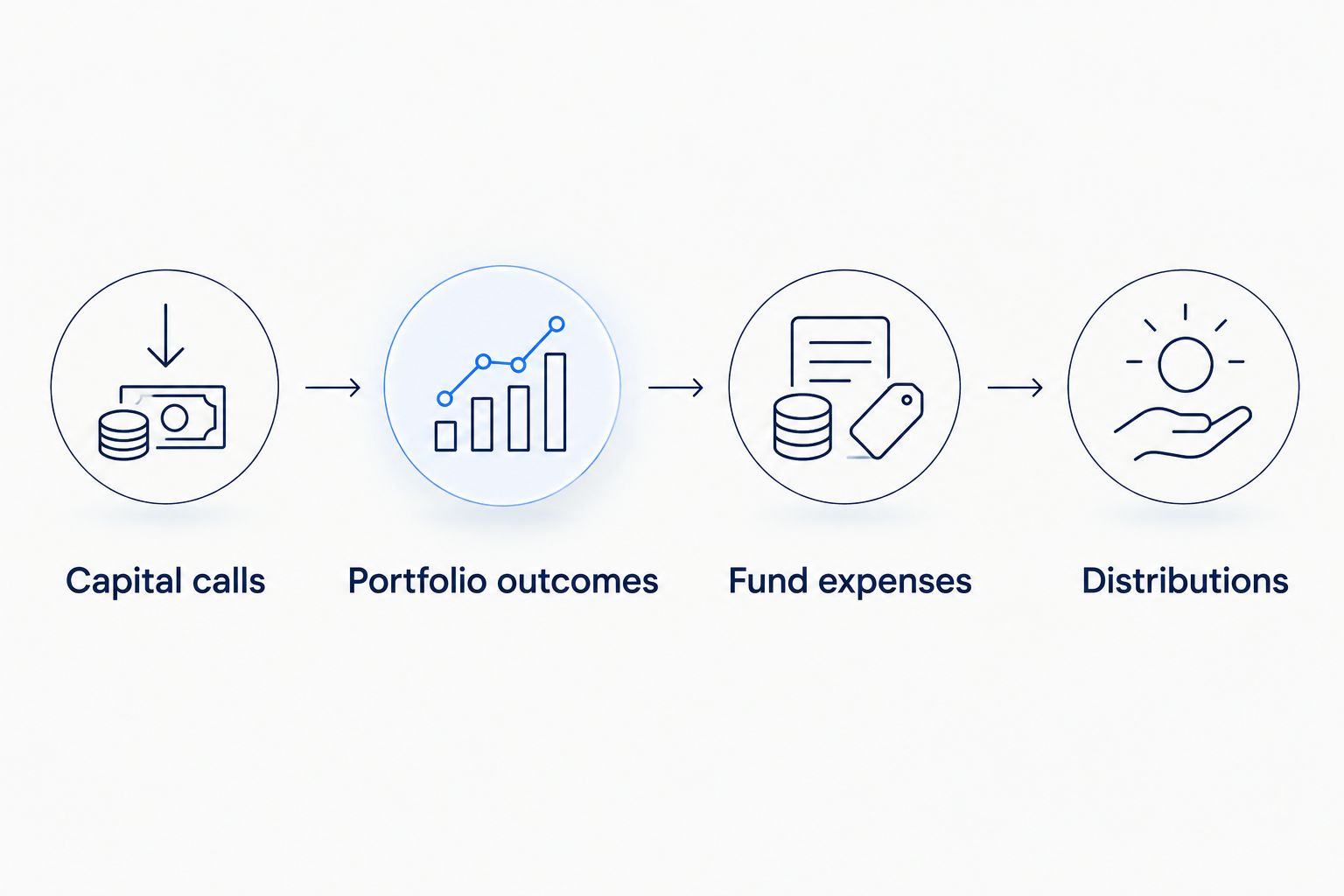
In 2026, ask the manager to separate committed capital, contributed capital, reported fund value and cash distributed in every performance discussion. They answer different questions. A commitment shows what you have agreed to provide; a distribution shows what you have actually received.
Capital calls turn a commitment into an obligation
You do not have to receive a distribution before another call arrives. Read when the manager can call capital and what the agreement says about missed calls. If you cannot meet the commitment on those terms, the investment does not fit your cash position, regardless of how persuasive the portfolio looks.
Paper gains do not pay back an LP
A portfolio company can gain value without producing cash for the fund. Your statement may show an increased valuation, but an exit or another realisation is still needed before that value can support a cash distribution. Treat valuation and liquidity as separate entries in your diligence notes.
Fund-level proceeds are what count
One successful exit does not establish that the whole fund made money for its LPs. Other positions can lose value, and fund expenses reduce what is available to distribute. Ask for results at the fund level and for the method used to calculate returns after fees and expenses.
Why VC fund losses vary
No single startup outcome tells you what an LP will receive. These factors determine how investment results reach you:
- Portfolio concentration. If a large share of fund capital depends on a small set of companies, those outcomes carry more weight in the fund’s result. Ask how the manager sets position sizes and handles follow-on investments.
- Realised versus unrealised value. A valuation reflects an estimate of an unsold position. A realised exit produces proceeds the fund can account for and potentially distribute.
- Fund expenses. Management fees and other expenses affect the amount left for LPs. Read what the fund pays, rather than relying on a headline description of carry.
- Distribution terms. The governing documents determine how proceeds are allocated between LPs and the manager. Read the waterfall before assuming that a company exit means an immediate payment to you.
- Time to liquidity. Capital can remain committed or invested while the fund waits for realisations. That restriction matters even if the eventual return is positive.
- Capital-call terms. The timing of calls changes how much cash you must keep available outside the fund. Default provisions matter most when a call arrives at a difficult time.
For a 2026 commitment, put each factor next to a clause in the fund documents or a specific answer from the manager. If you cannot locate the term, you cannot assess it from a pitch deck alone.
How do you assess the downside before committing?
Use a downside review that starts with obligations, not projected exits. A manager’s strongest company is not the right starting point for deciding whether you can bear a loss.
- Read the commitment and capital-call provisions. Identify what you agree to contribute, when the manager can request it and the consequences of missing a call.
- Trace the fund’s costs. Find the management fee, fund expenses and carry provisions. Ask which amounts the fund pays and how they affect LP distributions.
- Examine the investment process. Ask how the manager sources, selects and monitors companies, and who makes final investment decisions.
- Separate valuations from cash outcomes. Request reporting that distinguishes unrealised holdings, realised proceeds, capital contributed and distributions paid.
- Read the distribution waterfall. Identify the order in which proceeds reach LPs and the manager under the governing documents.
- Test your own liquidity. Decide whether you can meet calls and leave contributed capital invested without relying on an exit at a particular date.
In 2026, the useful question is not whether the manager has a convincing upside case. It is whether you understand what you still owe and what you could receive if the portfolio disappoints. Get legal and tax advice on the documents and your circumstances before you sign; an educational article cannot determine your obligations under a particular fund agreement.
AngelSchool teaches angel investors and aspiring VCs how to evaluate startups and build investment syndicates through cohort-based programs. AngelSchool is best for aspiring VCs and angel investors who want to sharpen investment diligence; it does not replace review of a VC fund’s governing documents. If you want to develop that diligence before assessing a commitment, start with AngelSchool.
Build your investment diligence
Explore AngelSchool’s education programs for angel investors and aspiring VCs.
Can you lose your entire VC fund investment?
Yes, you can lose all capital contributed if the fund produces no distributions to you. Do not confuse that outcome with having no further obligation: check whether any committed capital remains subject to calls under the agreement. In 2026, review both the amount already contributed and the commitment still outstanding.
Can you lose money even if some startups succeed?
Yes, an LP can have a net loss despite successful portfolio companies. Proceeds from those companies must be considered alongside failed investments, fund expenses and the distribution terms. Ask for fund-level net results rather than a list of notable exits.
Does limited liability mean your capital is protected?
No. Limited liability does not protect contributed capital from investment losses. It concerns the scope of an LP’s obligations; it is not a guarantee of repayment. For a 2026 fund commitment, have the governing documents reviewed so you understand the obligations that apply to you.
FAQ
Can you lose money as a limited partner in a VC fund?
Yes. An LP can receive less than the capital contributed, including no distribution, if fund proceeds do not cover investment losses and costs.
Can a VC fund lose all of an LP’s contributed capital?
Yes. If the fund cannot generate proceeds available for LP distributions, contributed capital can be lost. Check the agreement for any outstanding commitment as a separate issue.
Do capital calls mean I have to invest more after joining a fund?
Capital calls require you to contribute under the commitment you agreed to in the fund documents. Read the call and default provisions before signing.
Is a startup’s higher valuation the same as money returned to an LP?
No. A higher valuation is not a cash distribution. Look separately at unrealised value, realised proceeds and cash paid to LPs.
Can an LP lose money if the fund has a successful exit?
Yes. One exit can be outweighed by other losses and fund costs. Evaluate the fund’s net result rather than an individual company outcome.
Does limited partner status guarantee that I get my money back?
No. Limited partner status does not guarantee repayment of contributed capital. The fund’s investments and distribution terms determine what comes back.
What should I read before making a VC fund commitment in 2026?
Read the commitment, capital-call, fee, expense, default and distribution provisions. Review the manager’s investment process and seek advice on the specific legal and tax terms.
One last thing
A fund can report a valuable portfolio and still be unable to distribute that value to you today. Before a 2026 commitment, ask for capital contributed, cash distributed and unrealised value as separate figures. AngelSchool’s venture education can help you frame the diligence; the fund documents and manager’s answers determine the risk you actually accept.